






QKD vs post-quantum cryptography is not simply a choice between two versions of the same security technology. Both are intended to address risks associated with future quantum attacks, but they work differently and impose different requirements on a network. Quantum key distribution, or QKD, uses quantum communication to establish or distribute cryptographic key material. Post-quantum cryptography, or PQC, uses cryptographic algorithms designed to resist attacks from both conventional and sufficiently capable quantum computers.
That distinction matters when a security or network team evaluates a quantum-safe architecture. A QKD deployment can introduce dedicated physical and network requirements, while a PQC-based encryptor can protect conventional network traffic using quantum-resistant algorithms. Hybrid systems can combine mechanisms rather than forcing an organisation to treat QKD and PQC as mutually exclusive choices.
Direct answer
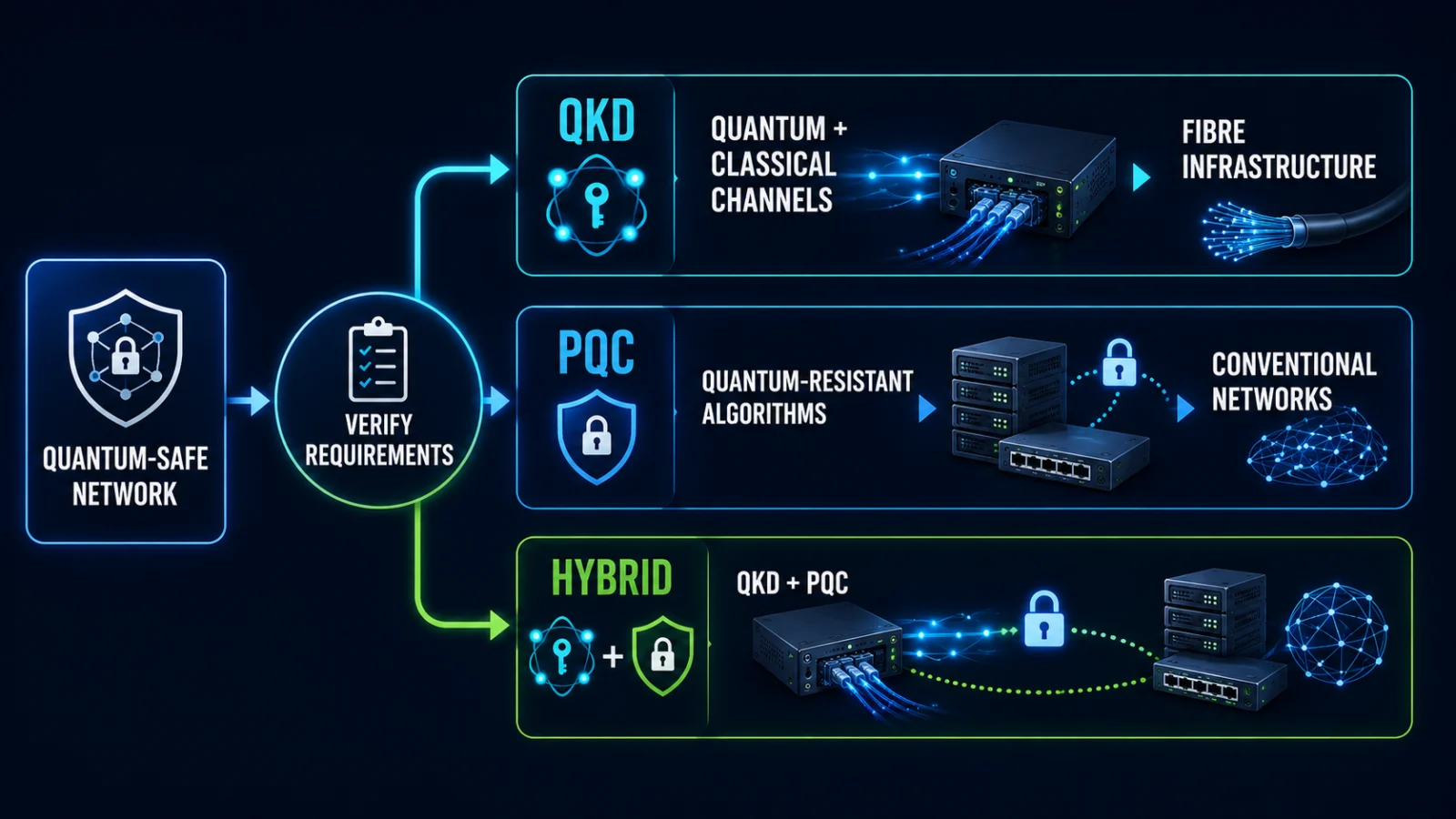
Use the QKD-versus-PQC question as an architecture decision, not a contest over which technology is universally better. QKD is relevant when an organisation can support the infrastructure required to distribute keys using quantum communication. PQC is relevant when quantum-resistant cryptography needs to operate through conventional network and software architectures. Hybrid designs can combine PQC, classical cryptography and externally supplied QKD keys. The appropriate design depends on the threat model, network layer, infrastructure, throughput, interoperability and validated security requirements.
Why C-DOT’s new portfolio makes the distinction easier to see
On 31 August 2026, C-DOT unveiled a portfolio of 14 indigenous quantum-security products. The portfolio spans QKD systems, post-quantum cryptography encryptors, secure communication products and specialised quantum components. That makes it a useful real-world example of why the label “quantum-safe” does not describe one architecture.
The launch itself does not establish that every organisation must migrate now, that every product is generally available for purchase, or that one approach should replace the other in every network. Those questions require separate evidence.
QKD vs post-quantum cryptography
| Decision point | QKD | PQC |
|---|---|---|
| Core approach | Uses quantum communication mechanisms to establish or distribute cryptographic key material. | Uses quantum-resistant cryptographic algorithms for operations such as key establishment and digital signatures. |
| Network dependency | The reviewed C-DOT QKD system uses quantum and classical channels over standard single-mode fibre. | PQC-based network encryption can operate through conventional IP and network-security architectures. |
| Example from C-DOT | C-DOT’s QKD systems, including its Q-AKSHAY family. | Q-SETU and other PQC-based encryption products. |
| Hybrid use | QKD-generated key material can be supplied to compatible encryption systems. | PQC can operate alongside classical cryptography and, in supported products, external QKD keys. |
| What it does not prove | QKD availability does not mean every network needs a QKD deployment. | PQC support does not mean migration is automatic or operationally trivial. |
What QKD changes in the network
C-DOT’s reviewed QKD documentation describes a system that uses standard single-mode optical fibre for quantum and classical channels. It also describes interfaces intended to supply generated key material to compatible encryption applications. This makes the physical and network architecture part of the QKD decision.
The identified C-DOT QKD system is not supported by the evidence as merely a laboratory concept. C-DOT documents integration testing with its transport equipment, while the reviewed material records TEC Technology Approval for the identified QKD system. That approval should not, however, be extended to every product in the newly unveiled 14-product portfolio unless product-specific evidence supports it.
What PQC changes
Post-quantum cryptography takes a different route. Instead of requiring a quantum channel to establish key material, PQC uses cryptographic algorithms designed to remain secure against quantum-capable adversaries. This allows PQC to be incorporated into conventional computing and network-security systems.
C-DOT’s Q-SETU provides a concrete example. Its current product documentation describes support for ML-KEM for quantum-resistant key establishment and ML-DSA for digital signatures, alongside hybrid classical and post-quantum operation. The product also supports network-security mechanisms including IPsec, demonstrating how PQC can be integrated into conventional IP-network protection.
QKD and PQC can work together
The two approaches do not have to be treated as mutually exclusive. C-DOT’s Q-SETU documentation includes support for external QKD key loading as well as classical and post-quantum key-exchange mechanisms. A network architecture can therefore use PQC while also incorporating key material from a QKD system where the infrastructure and security design justify it.
This is an important distinction for organisations planning a longer-term quantum-security transition. The practical question is not simply “QKD or PQC?” but which mechanisms are appropriate for a particular network, threat model and operational constraint.
How to think about the choice
- Start with the threat model. Identify which communications and cryptographic assets need protection against long-term quantum risk.
- Check the network architecture. Determine whether the environment can support the physical and operational requirements of QKD or whether quantum-resistant protection needs to work through conventional IP/network infrastructure.
- Identify the protection layer. Requirements at optical, Ethernet and IP layers can lead to different product and architecture choices.
- Check performance and interoperability. Throughput, interfaces, existing encryption equipment and key-management integration matter before selecting a design.
- Consider hybrid operation. Where supported and justified, classical cryptography, PQC and QKD do not have to be deployed as isolated alternatives.
- Verify the product state separately. Technical capability does not establish current pricing, general availability, procurement terms, certification or suitability for a particular organisation.
Does the C-DOT launch mean organisations must migrate now?
No such mandatory migration requirement was established by the reviewed C-DOT and government launch evidence. The announcement establishes a broader indigenous quantum-security product portfolio; it should not be interpreted as a regulatory direction requiring every telecom operator, bank, enterprise, government department or critical-infrastructure organisation to adopt these products immediately.
A binding migration requirement would need to come from the relevant controlling standards, regulator, government authority or organisation-specific security policy. Product availability and a regulatory obligation are separate questions.
Can organisations buy all 14 products now?
The reviewed evidence does not establish general commercial orderability for every product in the portfolio. Product-by-product pricing, procurement routes, support terms, deployment availability and certification or security-evaluation status were not established for all 14 products.
That uncertainty is important. An organisation evaluating a deployment should distinguish an announced technical capability from a verified procurement-ready product with confirmed interfaces, certification, support and commercial terms.
What network teams should take from the launch
C-DOT’s portfolio demonstrates that a quantum-safe network can involve several layers and mechanisms rather than one replacement encryption product. QKD addresses secure key distribution through quantum communication. PQC provides quantum-resistant cryptographic algorithms that can be integrated into conventional systems. Hybrid architectures can combine mechanisms where the network and threat model justify the added complexity.
The useful first step is therefore architecture assessment rather than product selection. Establish what must be protected, how long the information must remain secure, what network infrastructure is available, which layer requires protection, what performance is required and which standards or certifications control the deployment. Only then does a specific QKD, PQC or hybrid product comparison become meaningful.
Verification notes
ThePulseSignal reviewed the 31 August 2026 C-DOT/Department of Telecommunications announcement describing the 14-product quantum-security portfolio and current C-DOT technical material for its QKD and Q-SETU systems. The comparison separates documented product capabilities from editorial synthesis about architecture choices. General commercial availability, pricing, procurement terms and product-by-product certification for the complete portfolio remain unresolved and are not assumed.