






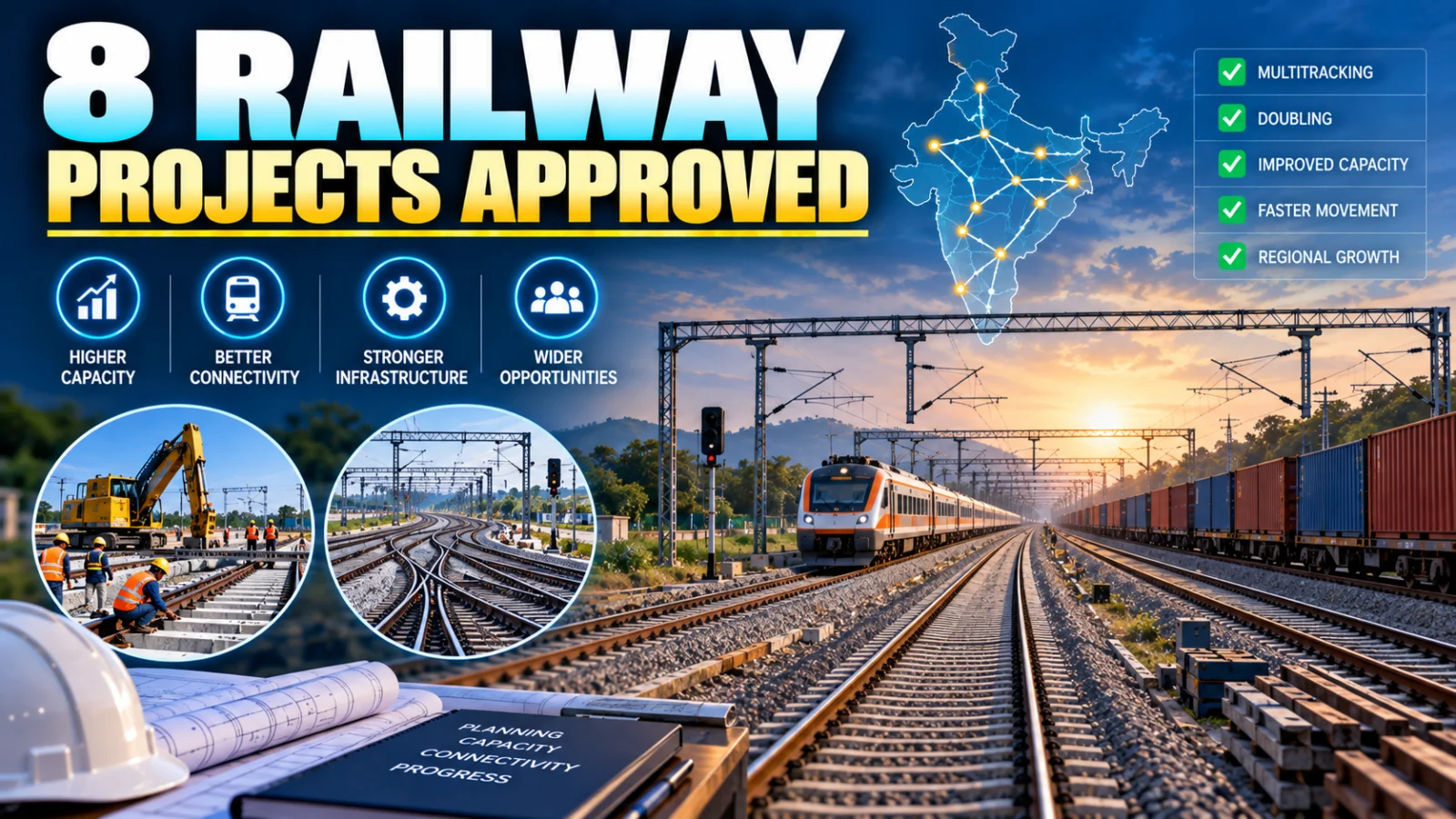
The railway multitracking projects 2026 approved by the Cabinet Committee on Economic Affairs cover eight Indian Railways capacity projects across nine states. The two approval packages together have an estimated cost of about ₹20,804 crore and are expected to add roughly 1,196 km to the railway network.
The important distinction is that Cabinet approval does not mean the additional tracks or capacity are operational now. The September 9 decision confirms the projects and their sanctioned investment state. Tendering, construction, traffic-management arrangements, commissioning and any actual increase in passenger or freight operations are later stages.
Which railway multitracking projects were approved?
The eight approved projects are Kharagpur–Jharsuguda (Bagdehi) fourth line; Katni–Pendra Road fourth line; Bilaspur (Uslapur)–Pendra Road third line; Arakkonam–Renigunta third and fourth lines; Whitefield–Bangarapet third and fourth lines; Hosur–Omalur doubling; Salem–Karur–Dindigul doubling; and Secunderabad (Ghatkesar)–Kazipet multitracking.
Together, the projects cover parts of Tamil Nadu, Andhra Pradesh, Karnataka, Telangana, West Bengal, Jharkhand, Odisha, Madhya Pradesh and Chhattisgarh.
What changes after Cabinet approval?
The immediate change is administrative and investment-related: the projects have moved into an approved capital-project state. That matters because the Railways can proceed through the implementation lifecycle subject to project-specific tendering, execution, land, engineering and operating requirements.
What has not automatically changed is equally important. The approval does not by itself establish new train frequencies, shorter journey times, additional passenger services, construction blocks or commissioned line capacity. Those effects should be reported only when the relevant railway authority publishes a later project-specific state.
How much capacity could the projects add?
The government says the projects are intended to increase line capacity, reduce congestion, improve operational efficiency and strengthen freight and logistics movement. For the southern project package, the official estimate points to about 47 million tonnes per annum of additional freight capacity. For the eastern and central package, the official estimate is about 27 million tonnes per annum.
Taken together, those official projections amount to roughly 74 million tonnes per annum of possible additional freight capacity. This is a projected benefit, not capacity already realised on September 9.
When are the projects expected to be completed?
The official Cabinet releases state that the projects are planned for completion up to 2029-30. The reviewed approval evidence does not establish one common commissioning date for all eight projects, and TPS is not treating that planning horizon as a guaranteed project-by-project completion date.
What should readers watch next?
The next meaningful updates are likely to be project-specific: tender or contract awards, confirmed construction commencement, major engineering milestones, traffic or power blocks caused by works, revised project cost or schedule, line commissioning, opening to traffic and actual passenger or freight service changes.
TPS will treat those later developments as updates to this same railway multitracking projects 2026 canonical while the core reader task remains tracking the approved projects. A separate project URL is justified only when one corridor develops a materially different reader problem, such as a construction disruption, procurement action, commissioning event or concrete passenger-service consequence.
Verification note
TPS reviewed the two September 9 CCEA and PIB approval releases that together cover the eight projects and reconciled their project counts, costs, network additions, states, projected freight benefits and planned completion horizon. Project-specific tender, work-start, commissioning and service consequences remain unresolved until later controlling railway evidence is published.

