





The SEBI ESMA CCP MoU signed in September 2026 does not automatically give Indian clearing corporations European recognition. Its importance is more specific: it restores a regulatory cooperation arrangement that allows central counterparties supervised by SEBI to seek recognition from the European Securities and Markets Authority under the European Market Infrastructure Regulation, or EMIR.
That distinction matters because an agreement between regulators, an application for recognition and an actual ESMA recognition decision are three different stages. For readers trying to understand the India–EU clearing dispute, the new MoU is best viewed as a reopened regulatory route rather than the end of the process.
What is a central counterparty?
A central counterparty, usually shortened to CCP, sits between buyers and sellers in financial-market transactions. Instead of each trading participant carrying the full counterparty exposure to the other side, the CCP becomes the buyer to every seller and the seller to every buyer for transactions it clears.
This makes clearing houses important pieces of market infrastructure. Their risk controls, margin systems, default-management arrangements and financial resources can affect institutions across borders, which is why regulators supervise them closely.
Why does an Indian CCP need ESMA recognition?
Under the EU’s EMIR framework, a CCP established outside the European Union is treated as a third-country CCP. If that CCP wants to provide clearing services to EU clearing members or EU trading venues within the regulated framework, ESMA recognition becomes important.
Recognition is not simply an administrative label. ESMA assesses whether the legal and supervisory conditions required by EMIR are satisfied. One of those requirements involves cooperation arrangements between ESMA and the CCP’s home regulator so that supervisory information can be exchanged and risks can be monitored across jurisdictions.
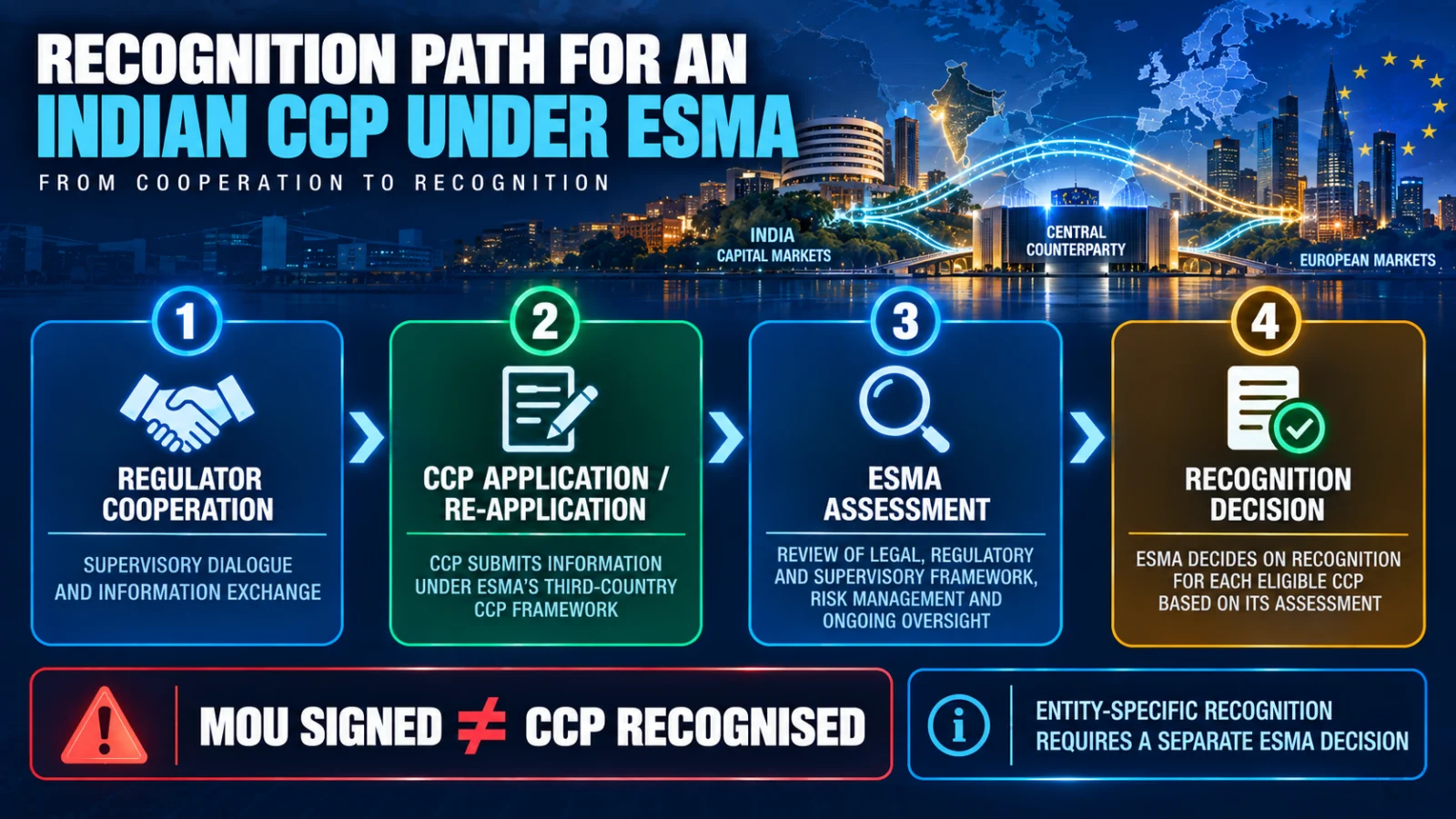
Regulator cooperation
ESMA and the Indian regulator responsible for the CCP establish arrangements for supervisory cooperation and information exchange.
CCP application
The individual Indian CCP must still apply or re-apply for recognition. The cooperation MoU does not itself recognise the CCP.
ESMA assessment
ESMA separately evaluates the CCP under its third-country recognition framework and determines whether the applicable requirements are met.
Recognition outcome
Only after a positive recognition decision can the specific CCP rely on that recognised status for relevant EU clearing access.
Why were Indian CCP recognitions withdrawn?
The current story goes back to 2022. ESMA announced that it would withdraw recognition from six Indian central counterparties because a required cooperation condition under EMIR had not been fulfilled with the relevant Indian authorities.
The six CCPs were not all supervised by the same regulator. Among them, Indian Clearing Corporation Limited, NSE Clearing Limited and Multi Commodity Exchange Clearing Corporation Limited were identified by ESMA as SEBI-supervised CCPs. Other Indian CCPs fell under different Indian regulatory authorities.
The key point is that the withdrawal was connected to the regulatory cooperation framework, not a finding that every Indian CCP had individually failed operationally. Without the required supervisory cooperation arrangement, a cumulative condition for recognition was not satisfied.
What changed in 2026?
During 2026, the India–EU CCP recognition structure began changing again. ESMA first concluded a cooperation arrangement with the Reserve Bank of India. That was followed by ESMA recognising RBI-supervised Clearing Corporation of India Limited, or CCIL, as a Tier 1 third-country CCP effective from June 30, 2026.
The September 4, 2026 SEBI–ESMA agreement is the next important step. ESMA says the new arrangement allows CCPs established in India and supervised by SEBI to re-apply for recognition under EMIR.
This creates a useful precedent for understanding the process: regulator cooperation can reopen the recognition route, but an individual CCP still needs its own recognition decision.
SEBI ESMA CCP MoU: what changed and what did not
| Question | Current evidence-backed position |
|---|---|
| Is there now a SEBI–ESMA cooperation framework for CCPs? | Yes. SEBI and ESMA announced the new MoU on September 4, 2026. |
| Can SEBI-supervised Indian CCPs seek ESMA recognition again? | Yes. ESMA says they can re-apply under the recognition framework. |
| Are ICCL, NSE Clearing and MCXCCL automatically recognised? | No. The MoU is not an individual recognition decision. |
| Has EU clearing access automatically resumed for every SEBI-supervised CCP? | No such blanket restoration is established by the reviewed evidence. |
| Does an ordinary retail investor have an immediate filing or compliance action? | No immediate retail filing, deadline or account-level action was identified from the reviewed material. |
What happens after a CCP applies?
ESMA’s third-country CCP framework requires a separate assessment of the applicant. Recognition decisions can also involve classification according to the CCP’s systemic importance to the European Union. A recognised third-country CCP may be classified as Tier 1 or Tier 2 depending on the applicable assessment.
The earlier CCIL decision shows how this can work in practice: after the RBI–ESMA cooperation arrangement was established, ESMA separately recognised CCIL as a Tier 1 third-country CCP. The same sequence should not be assumed automatically for SEBI-supervised CCPs until their applications and ESMA decisions are actually published.
Why does recognition matter for market participants?
The practical consequence is mainly institutional. Recognition affects the regulatory ability of EU clearing members and trading venues to use a third-country CCP within the EMIR framework. That can matter to banks, brokers, clearing members, exchanges and other institutions that depend on cross-border market infrastructure.
For an ordinary retail investor, however, the September MoU does not create an immediate investment decision, account change or compliance deadline. Its importance lies in the infrastructure behind markets rather than in a new retail trading rule.
What should readers watch next?
The most important future evidence will be entity-specific. Readers should watch for confirmed recognition applications or decisions involving Indian Clearing Corporation Limited, NSE Clearing Limited and Multi Commodity Exchange Clearing Corporation Limited. An application would show that the new cooperation framework is being used; an ESMA recognition decision would establish the next material state change.
Another relevant development would be a comparable cooperation arrangement involving India’s International Financial Services Centres Authority, because ESMA’s 2022 withdrawal decision covered Indian CCPs supervised by multiple authorities.
Verification note
ThePulseSignal reviewed SEBI’s September 4, 2026 press release, ESMA’s announcement of the new SEBI cooperation arrangement, ESMA’s 2022 recognition-withdrawal decision, ESMA’s permanent third-country CCP framework and its 2026 recognition decision for CCIL. These sources support the distinction between supervisory cooperation, re-application and actual recognition.
Limitations and unresolved facts
TPS has not established that ICCL, NSE Clearing or MCXCCL has already received a new ESMA recognition decision under the September 2026 MoU. The timing of individual applications, their eventual recognition outcome, possible Tier 1 or Tier 2 classification and the exact date of any entity-specific restoration of EU clearing access remain unresolved. No immediate retail-investor compliance action was identified in the reviewed sources.