




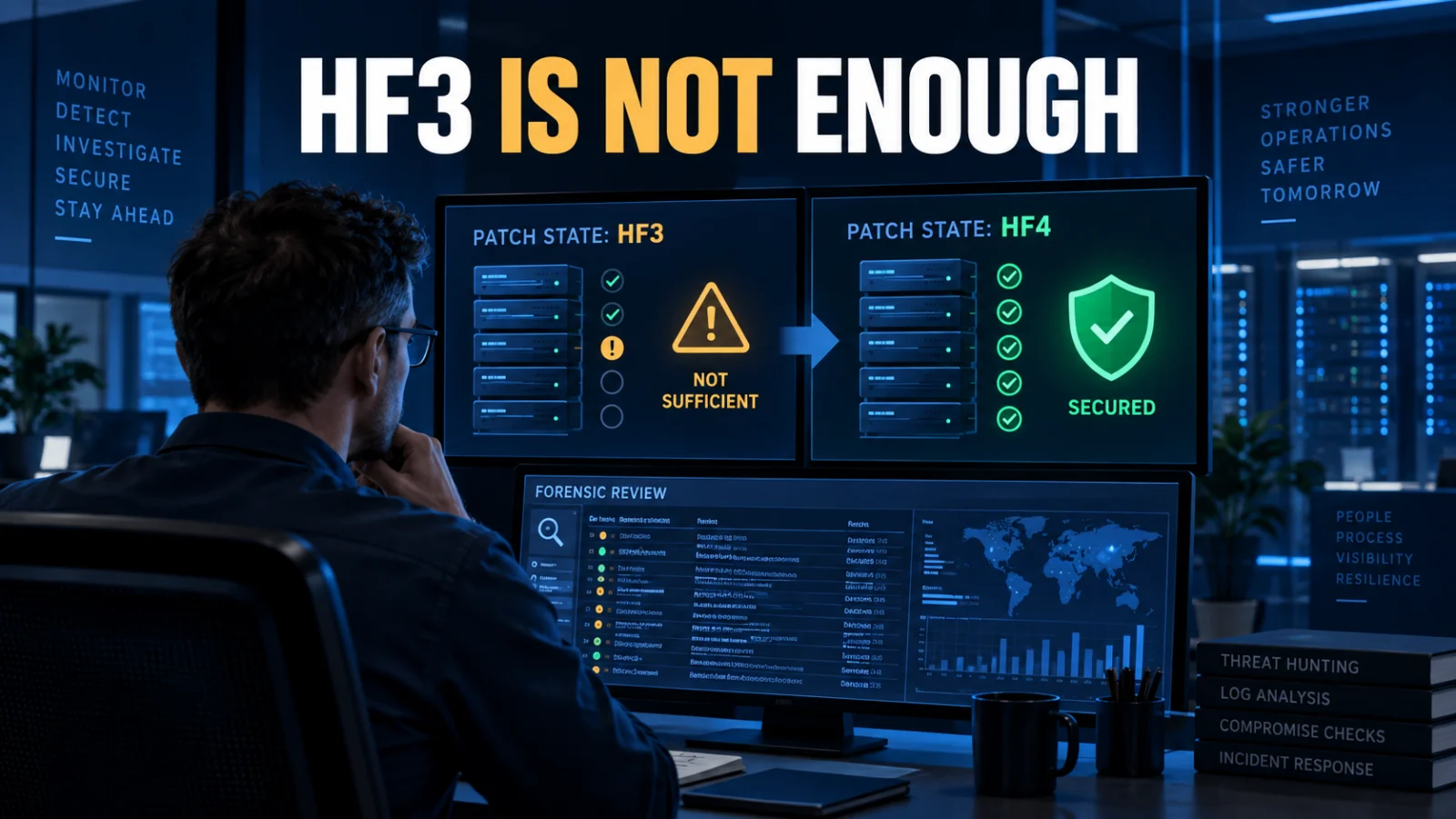
The CVE-2026-86218 patch state is straightforward for self-hosted N-central administrators: if your N-central server is running a build before 2026.3.1.14, including HF3 build 2026.3.1.13, it still needs N-central 2026.3 HF4. N-able released HF4 for a critical vulnerability that can allow pre-authentication remote code execution on the N-central server.
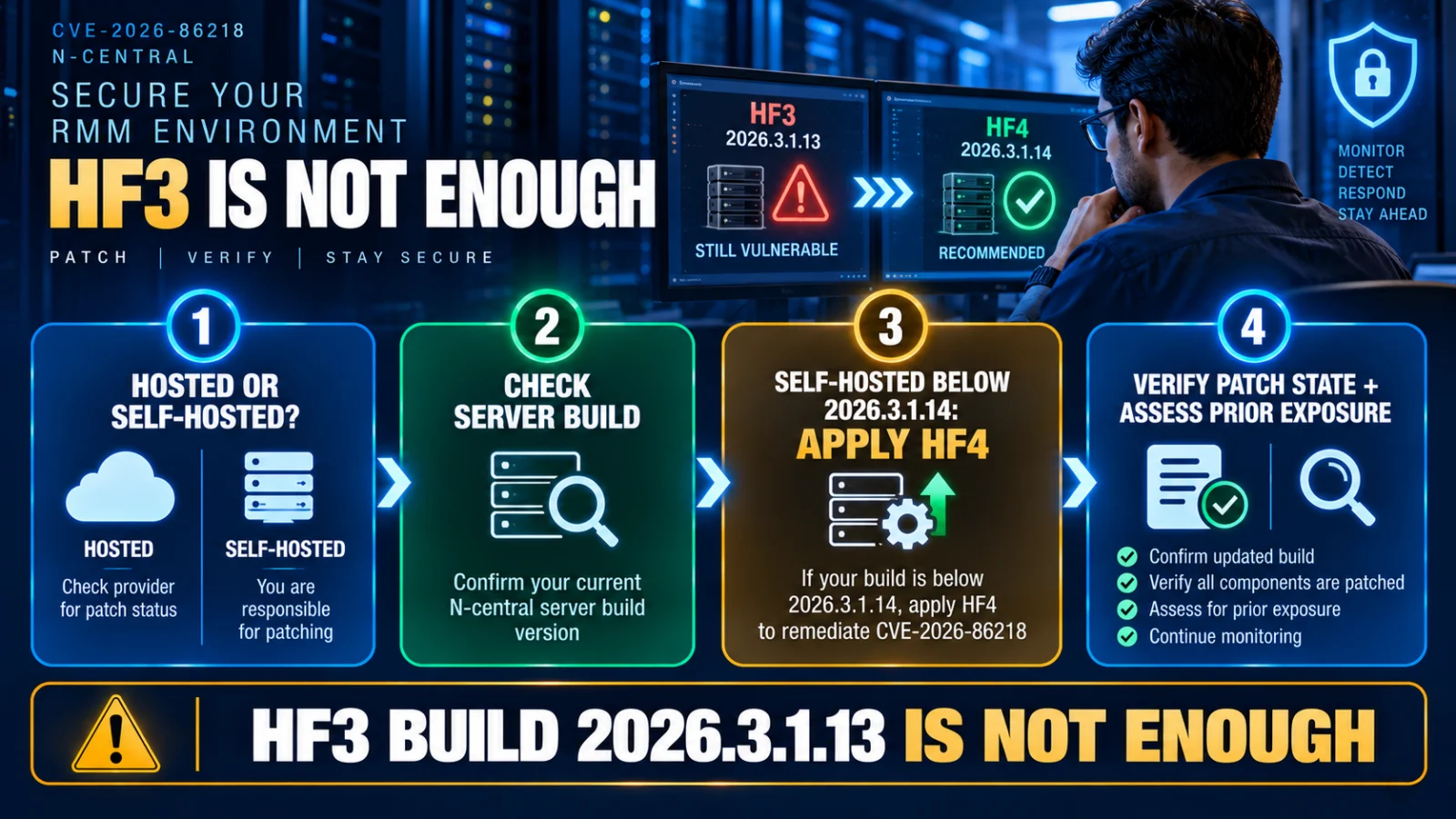
Direct answer: HF3 is not enough for CVE-2026-86218. Self-hosted N-central systems below build 2026.3.1.14 should follow N-able’s supported upgrade path to HF4. N-able says hosted N-central instances were patched by the company and do not require customers to install this hotfix themselves.
Why HF3 is not enough for CVE-2026-86218
N-able had already released N-central 2026.3 HF3 for separate vulnerabilities, but CVE-2026-86218 required another server hotfix. That means an administrator who recently installed HF3 can still be running an affected N-central server.
The important current state is therefore the exact server build, not merely whether a recent hotfix was installed. For CVE-2026-86218, the remediated HF4 build identified by N-able is 2026.3.1.14.
Which N-central systems are affected?
N-able’s current vulnerability material identifies N-central versions before 2026.3.1.14 as affected. The urgent customer action applies to self-hosted or on-premises N-central deployments that have not reached the HF4 build.
Hosted N-central is a different operational state. N-able says it applied the protection to hosted instances itself, so hosted customers should not treat the on-premises hotfix procedure as their own manual upgrade instruction.
If you use hosted N-central: N-able says the hosted service has already been patched. Confirm the current vendor incident guidance rather than attempting an on-premises server hotfix.
If you self-host N-central: Check the exact server build. A build below 2026.3.1.14 remains in the affected range identified for CVE-2026-86218.
If you are on HF3 build 2026.3.1.13: Upgrade again. HF3 addressed other vulnerabilities but does not complete remediation for CVE-2026-86218.
After HF4: Verify that the server is actually on the intended build, then treat any investigation of earlier compromise as a separate security task.
Was CVE-2026-86218 exploited in the wild?
This is the most important unresolved evidence conflict. N-able’s active incident page says the newly identified third vulnerability was observed exploited in the wild. However, N-able’s HF4 release notes say the company has no confirmation of exploitation in production.
Those statements should not be silently combined into a stronger claim. TPS therefore treats exploitation of CVE-2026-86218 as a conflicting first-party evidence state rather than stating either that exploitation definitely occurred everywhere or that there has been no exploitation.
Security firm Huntress linked the third N-central vulnerability to CVE-2026-86218 and reported active exploitation context, but its published investigation did not establish that its known customer compromise could be conclusively attributed to this specific CVE. That distinction matters.
Does installing HF4 prove the server was never compromised?
No such conclusion is supported by the reviewed evidence. A security hotfix closes the vulnerability state addressed by the patch; it does not by itself establish what happened before remediation.
N-able recommends auditing N-central user accounts for unexpected users. That is a useful vendor-directed check, but the reviewed guidance does not establish that a clean user list alone proves an exposed server was never compromised.
If an administrator finds suspicious accounts, unexpected activity or other evidence of compromise, that should move into the organisation’s normal incident-response process rather than being treated as a patch-installation problem only.
Do N-central agents also need an update for CVE-2026-86218?
N-able states that agent upgrades are not required specifically to protect against CVE-2026-86218. The vulnerability and HF4 remediation discussed here concern the N-central server. N-able still recommends keeping agents current as a general operational practice, but that should not be confused with the specific HF4 requirement.
What if your N-central version is older?
N-able lists supported direct upgrade paths to 2026.3.1.14 from recent N-central versions including 2025.4, 2026.1, 2026.2, 2026.3 and the 2026.3.1 hotfix builds. Administrators on older unsupported starting points may need an intermediate supported build before reaching HF4.
Because upgrade paths can change and production RMM infrastructure is consequential, administrators should use the current N-able release notes for their exact starting version rather than assuming every old build can jump directly to HF4.
What administrators should check now
- Determine whether the deployment is hosted by N-able or self-hosted.
- For self-hosted N-central, verify the exact server build rather than assuming HF3 is current.
- If the build is below 2026.3.1.14, follow N-able’s supported path to 2026.3 HF4.
- Verify the server reached the intended HF4 build after the upgrade.
- Review N-central user accounts for unexpected users as N-able recommends.
- Treat suspicious activity or compromise evidence as an incident-response issue separate from patch installation.
What remains unresolved
N-able’s public incident and release-note pages do not currently present a consistent exploitation statement. The number of affected or compromised servers is unknown, India-specific exposure is unknown, and TPS did not establish a complete indicator-of-compromise set for CVE-2026-86218.
TPS also did not verify a current CISA Known Exploited Vulnerabilities listing for this CVE. A later N-able clarification, CISA or CERT-In action, new compromise indicators, or another N-central hotfix would materially change the current assessment.
What happens next?
The most important next signals are an N-able reconciliation of its exploitation statements, closure or revision of the active incident, new compromise indicators, a subsequent hotfix, or an authoritative exploited-vulnerability designation. Any of those should trigger an immediate review of this article.
Verification note: ThePulseSignal reviewed N-able’s active N-central incident notice and its 2026.3 HF4 release notes, then reconciled the affected-build and exploitation statements with the completed security research. Where N-able’s own public statements conflict, this article preserves that conflict rather than selecting one as definitive.