






If your gold loan pledged jewellery is lost, damaged or returned with a material difference in weight, purity or condition, the lender’s responsibility does not end with saying the item was in storage. The current RBI gold-and-silver collateral framework gives borrowers specific protections around documentation, custody, damage, loss, discrepancies and compensation.
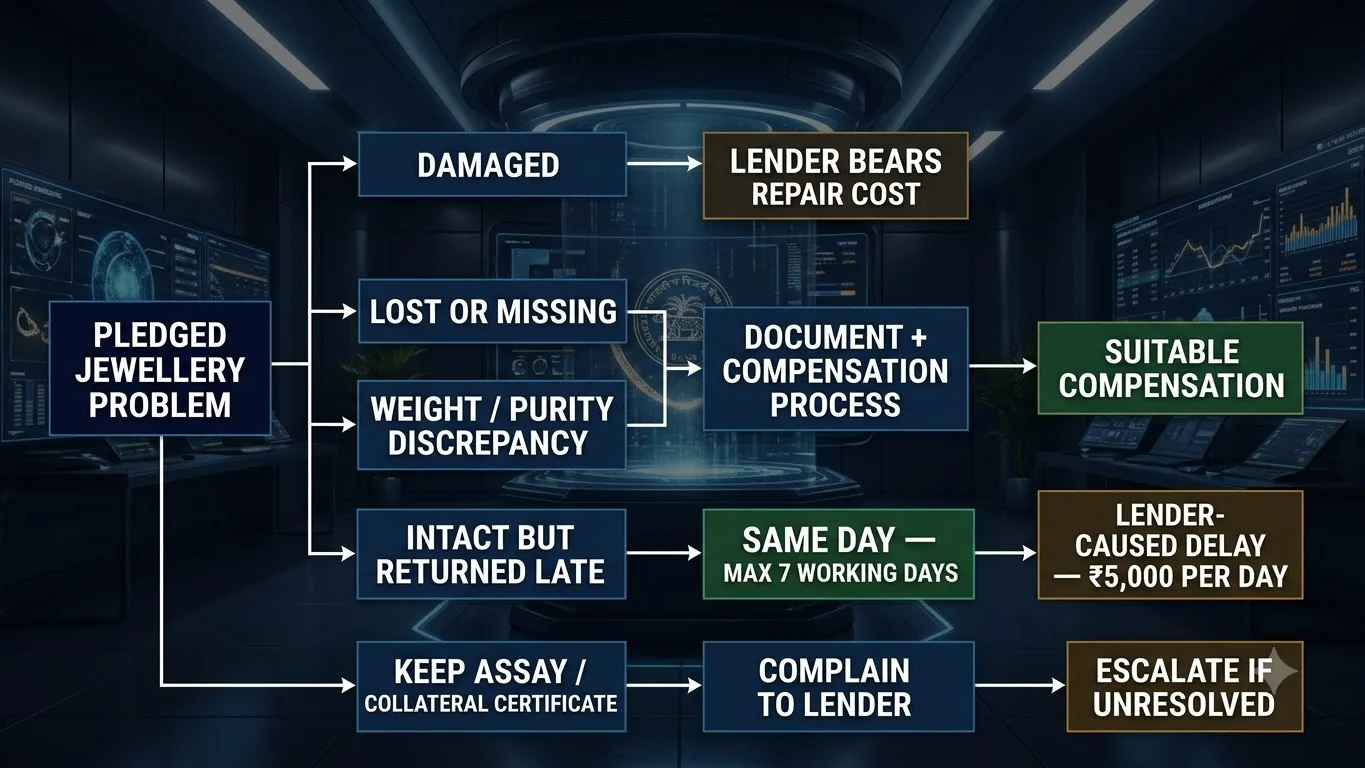
The most important distinction is this: damage, permanent loss and delayed return are not the same problem and do not use the same compensation rule. If the lender damages pledged collateral during the loan, the repair cost is borne by the lender. If collateral is lost, or there is a loss arising from deterioration or a discrepancy in quantity or purity, the lender must suitably compensate the borrower or legal heir. RBI does not prescribe one universal rupee formula for every lost-jewellery case.
The lender bears the repair cost for damage caused while the collateral is in its custody.
The lender must suitably compensate the borrower or legal heir under its applicable compensation process.
A material quantity or purity discrepancy falls within the RBI framework’s loss and compensation protections and should be documented immediately.
This is a different rule: collateral should normally be released on the same day and no later than seven working days after full repayment or settlement. Where the delay is attributable to the lender, the RBI framework provides ₹5,000 per day beyond the prescribed release timeline.
What RBI rules mean if pledged jewellery is lost
For lost collateral, the key RBI wording is suitable compensation. That is important because it means borrowers should not assume that every case automatically uses jewellery retail value, current showroom price, making charges, stones, sentimental value or a fixed RBI multiplier.
The exact amount can depend on the recorded collateral details, the lender’s compensation policy or standard operating procedure, the facts of the loss and, where a dispute continues, any consumer or legal determination. A recent court or consumer-commission award can be useful context, but it should not be treated as a universal RBI formula for every borrower.
What if the lender damages the jewellery?
The RBI framework is more direct on physical damage caused while collateral is held by the lender: the lender bears the repair cost. A borrower should document the condition of the jewellery as soon as it is presented for return and raise any visible difference before signing an acknowledgement that the collateral has been received in satisfactory condition.
What if the returned gold has a different weight or purity?
A dispute does not have to involve a completely missing ornament. The RBI framework also addresses deterioration and discrepancies in quantity or purity. This makes the original pledge documentation especially important.
The borrower should compare the returned item against the lender’s collateral or assay certificate and record any difference in gross weight, net precious-metal weight, purity, defects, identifying details or images that were documented when the jewellery was pledged.
Your strongest evidence is the original collateral certificate
The pledge record is not merely an administrative form. Under the RBI framework, the borrower should receive documentation recording material characteristics of the pledged collateral. Depending on the applicable format, this can include purity, gross weight, net gold or silver weight, deductions, existing defects or damage, images and valuation details.
Preserve that record along with the loan agreement, Key Facts Statement where applicable, repayment records, closure proof and all complaint correspondence. These documents can establish what the lender originally accepted and what should have been returned.
What to do if jewellery is missing, damaged or different
Check the item count, identifying description, images, gross weight, net precious-metal weight, purity and any pre-existing defects recorded when the loan was created.
Take clear photographs where useful and make a written record of any missing ornament, visible damage, weight difference or purity dispute.
If the collateral is not correct, avoid signing an acknowledgement stating that everything has been received satisfactorily until the discrepancy is recorded.
Ask the regulated lender to identify the applicable compensation process or SOP and provide its written response.
Keep complaint references, emails, branch letters, repayment proof, valuation records and any response describing the lender’s investigation or compensation offer.
If the lender’s grievance process does not resolve the issue, check whether the complaint qualifies for escalation through the RBI Integrated Ombudsman framework and RBI’s Complaint Management System.
Is ₹5,000 per day the compensation if the lender loses your gold?
No. The ₹5,000-per-day rule belongs to a separate problem: lender-attributable delay in releasing collateral after full repayment or settlement beyond the prescribed release period.
For an outright loss, damage or quantity/purity discrepancy, the RBI framework instead requires repair cost or suitable compensation, depending on the problem. Mixing these two rules can give borrowers the wrong expectation about what they can claim.
How quickly should jewellery be returned after repayment?
Where the pledged collateral is intact and the loan has been fully repaid or settled, the RBI framework requires release on the same day, with an outer limit of seven working days.
If the lender itself causes a delay beyond that period, the borrower is entitled to the prescribed ₹5,000-per-day compensation for that delayed-release state. That does not replace any separate remedy that may apply if the collateral is actually missing or damaged.
Is pledged jewellery automatically insured?
Do not assume that RBI gives every borrower a direct, universal insurance entitlement. Individual lenders may maintain insurance arrangements for pledged collateral, and some lenders publicly state that their stored gold is insured against loss or damage. But the lender’s own insurance arrangement is different from the borrower’s RBI compensation right.
For a dispute, the practical question is not only whether the lender has insurance. It is what the RBI rules, loan contract and lender compensation policy require the lender to do for the borrower.
Can a consumer court award more?
Consumer forums and courts can decide individual disputes based on their facts and applicable law. Recent cases involving missing pledged gold show that borrowers may obtain compensation beyond a simple return-of-collateral dispute, but those awards are case-specific.
Do not treat one award involving market value, making charges, compensation for harassment or litigation costs as an automatic entitlement in every gold-loan case.
When should you escalate beyond the lender?
Start with the lender’s formal grievance channel and preserve proof that the complaint was lodged. If the complaint remains unresolved and falls within the applicable RBI Ombudsman framework, the borrower can check eligibility to escalate through RBI’s Complaint Management System.
A complex dispute involving large monetary loss, contested valuation, alleged fraud or disagreement over legal compensation may also require independent legal or consumer-law advice. TPS does not determine the value of an individual claim.
What this article does not cover
This page is about loss, damage and collateral discrepancy while jewellery is under lender custody. A lender simply taking too long to return otherwise intact jewellery after repayment is a related but different borrower-rights problem. Gold-loan auction after default, loan valuation, LTV rules and ordinary household jewellery insurance are also separate reader jobs.
Verification method
ThePulseSignal reviewed the current RBI gold-and-silver collateral framework covering custody, borrower collateral records, loss or damage compensation and release after repayment, then checked recent borrower disputes and current lender disclosures to distinguish regulatory rights from lender-specific practices and case-specific awards.
Limitations and unresolved facts
RBI does not set one universal numerical compensation formula for every case of lost pledged jewellery. The final amount can depend on the recorded collateral, lender policy, contractual terms, the specific cause and extent of loss, and any later adjudication. Lender insurance arrangements also vary and should not be presented as a universal borrower entitlement.