





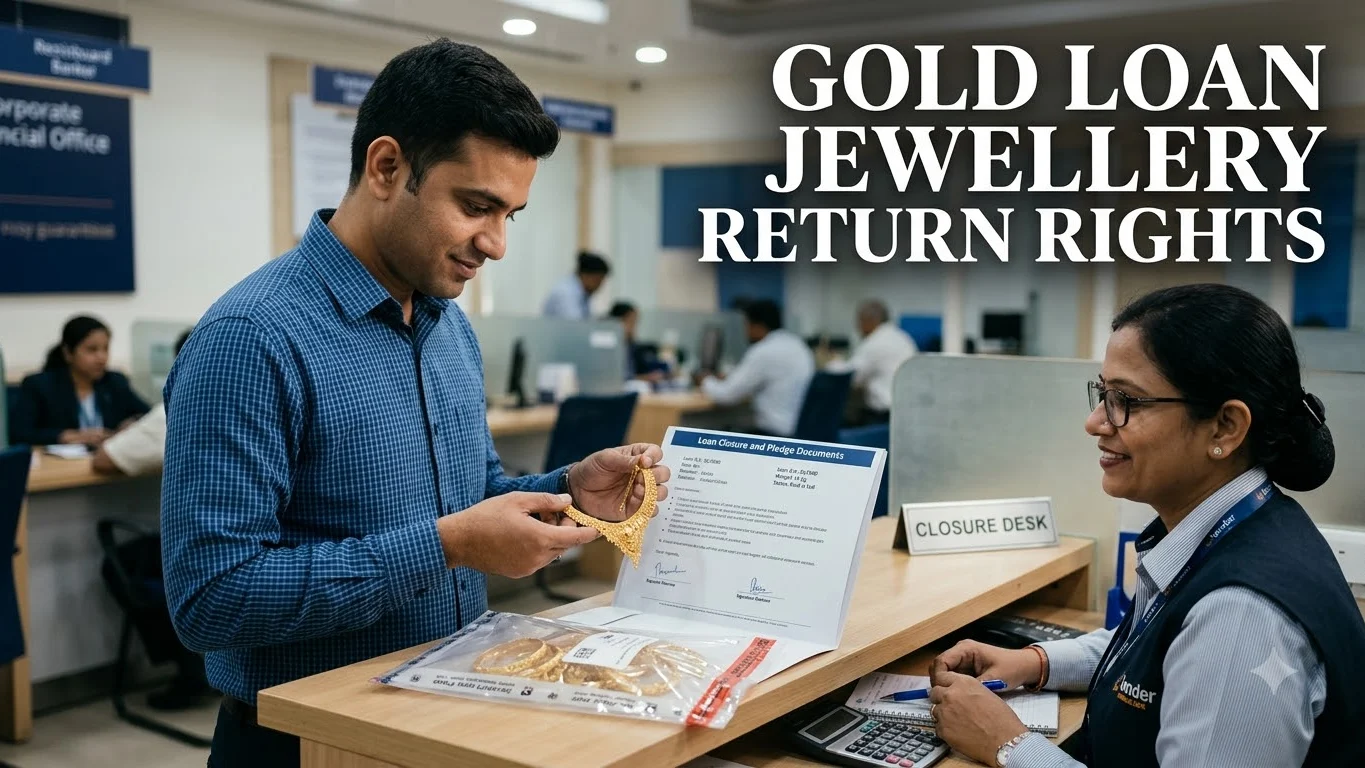
If you have fully repaid or settled a gold loan, the lender should return your pledged jewellery on the same day where possible and, in any case, within seven working days. Under the current RBI borrower-protection framework, if the lender itself causes a delay beyond that maximum period, compensation of ₹5,000 for each additional day of delay applies.
Gold loan jewellery return: the direct answer
The return obligation begins after full repayment or settlement of the loan. The lender should release the pledged eligible collateral promptly, with seven working days acting as the outer limit rather than the normal waiting period. The ₹5,000-per-day compensation rule is not automatic from the date you repay the loan; it applies when the permitted return period has expired and the continuing delay is attributable to the lender.
First, make sure the gold loan is actually closed
Before treating the jewellery as overdue, confirm that the lender has received the full amount required to close or settle the loan. Keep evidence showing the date and amount of the final payment, the loan or account number and any closure or settlement acknowledgement issued by the lender.
This matters because the regulatory return timeline is tied to full repayment or settlement. A payment that reduces the outstanding balance but does not fully close the loan is a different state and should not be treated as full closure.
What to do after full repayment
- Keep proof of closure. Save the final payment receipt, settlement confirmation and account or loan number.
- Ask for collateral release immediately. Record when and how you requested return of the jewellery.
- Take the original pledge or assay certificate if available. It helps you match the returned ornaments against the recorded description, weight, quantity and other details.
- Inspect the jewellery before acknowledging receipt. Check that the items returned correspond to the lender’s recorded collateral details.
- If return is delayed, complain in writing. Preserve the complaint number, email, branch acknowledgement or other proof.
- Escalate if the lender does not resolve the complaint. Where the regulated entity and complaint are covered by the RBI Integrated Ombudsman Scheme, the RBI grievance route may become available after the lender’s response process is exhausted.
Is the limit seven calendar days or seven working days?
The controlling wording uses seven working days, not seven calendar days. Weekends and applicable holidays can therefore affect the last permissible day.
That does not mean a lender should routinely keep pledged jewellery for seven working days. The RBI framework expects the collateral to be returned on the same day where possible, with seven working days serving as the maximum permitted period.
When does ₹5,000-per-day compensation start?
The compensation safeguard applies when the lender is responsible for a delay that continues beyond the permitted seven-working-day return period.
For example, if full repayment is completed and the maximum return period expires but the lender continues withholding the collateral because of its own processing failure, the borrower may become entitled to ₹5,000 for each additional day of lender-attributable delay.
The compensation should therefore not be described as ₹5,000 from the first day after repayment, and it should not be presented as automatic when the delay is caused by circumstances outside the lender’s responsibility.
Is your jewellery actually overdue?
Loan not fully repaid or settled: the post-closure return rule has not yet been triggered.
Loan fully repaid and less than seven working days have passed: request immediate release and preserve proof, but the maximum RBI period may not yet have expired.
More than seven working days have passed because of lender-side delay: raise the delay and the ₹5,000-per-day compensation safeguard in your written complaint.
Lender says the delay is outside its control: ask for the reason in writing and preserve that response. The compensation rule should not be assumed to apply regardless of cause.
What should you check when the jewellery is returned?
Do not treat the handover as a formality. Compare the returned collateral with the certificate or documentation issued when the gold was pledged.
Check the number and description of ornaments, recorded weight, purity information where stated and any identifying details that were documented at the time of pledge. If something appears different, missing or damaged, raise the issue before signing an acknowledgement that could later be treated as confirmation that everything was returned correctly.
What evidence should you preserve if the lender is delaying return?
- Loan or account number.
- Final repayment or settlement receipt.
- Loan closure confirmation, if issued.
- Original pledge, assay or collateral certificate.
- Date you first asked for the jewellery to be released.
- Branch acknowledgements, emails, SMS messages or complaint numbers.
- Any written explanation the lender gives for the delay.
- Proof of the actual date on which the jewellery was ultimately returned.
These records help establish both when the loan ended and how long the lender retained the pledged collateral afterwards.
What if the lender says you did not come to collect the jewellery?
The RBI framework also recognises situations where the borrower or legal heir does not approach the lender to collect released collateral. Lenders are expected to communicate and remind the borrower rather than simply treating uncollected jewellery as abandoned.
If the dispute is about whether you were informed that the jewellery was ready, preserve messages, call records, letters and branch communications showing when release was offered and when you attempted collection.
What if the jewellery is damaged, missing or different?
A delayed return and damaged or missing collateral are related but different borrower problems.
Current RBI safeguards place responsibility on lenders for pledged collateral while it is in their custody. Where collateral is damaged, repair-cost protections apply, while loss, deterioration or discrepancies involving quantity or purity can trigger separate compensation obligations.
If your main problem is that the lender returned damaged, missing or materially different jewellery, document the discrepancy immediately rather than treating it only as a delay complaint.
Can you complain to RBI immediately?
The normal grievance path starts with the lender. Send a written complaint to the regulated entity and retain the acknowledgement.
Under the current Reserve Bank – Integrated Ombudsman Scheme, 2026, eligible complaints involving covered regulated entities can be escalated when the lender does not resolve the issue satisfactorily or does not respond within the applicable complaint-response period. The RBI’s grievance framework is a second-stage remedy, not a substitute for first raising the complaint with the lender.
An Ombudsman complaint also does not guarantee that compensation will be awarded. The outcome depends on the facts, the regulated entity’s response and the applicable RBI rules.
Does this rule apply to every old gold loan?
The RBI’s harmonised gold and silver collateral framework was introduced in 2025 with a transition period for regulated lenders. Current new lending is governed by the adopted framework, but an older loan sanctioned before a lender adopted the harmonised Directions can require a closer check of the lender category, sanction date and applicable earlier instructions.
If your dispute involves an older loan, do not rely only on the current rule summary. Ask the lender which regulatory framework it says governs that loan and compare that answer with the applicable RBI directions.
What if you made only a part payment?
Partial repayment is not the same as full closure. Whether a borrower can obtain release of one or more pledged ornaments before full repayment depends on the remaining loan balance, collateral adequacy and the lender’s applicable part-release process.
This article deals specifically with the state after full repayment or settlement, when the borrower’s central problem is recovery of the pledged jewellery.
What if you have not repaid the loan?
If the loan remains unpaid or has entered default, the issue shifts from post-repayment collateral return to default, notice and auction rights. Those are separate legal and borrower-action questions and should not be confused with the seven-working-day post-closure return rule.
A practical complaint sequence
- Confirm and document full repayment or settlement.
- Request return of the jewellery and note the request date.
- Count the applicable working days, not calendar days.
- If the jewellery is not returned, ask the lender for a written explanation.
- If lender-caused delay exceeds the maximum period, refer specifically to the RBI collateral-return and delay-compensation safeguard.
- Escalate through the lender’s grievance officer or nodal channel.
- If the complaint remains unresolved and is eligible under the RBI Ombudsman framework, use the applicable RBI grievance route.
Verification note
ThePulseSignal reviewed the RBI’s gold and silver collateral borrower-protection framework, current RBI grievance guidance and current lender implementation material. The key verified protections are the same-day return expectation, the maximum seven-working-day limit and ₹5,000-per-day compensation where delay beyond that period is attributable to the lender.
Limitations and unresolved facts
The exact branch process, documents requested at collection and operational turnaround can differ by lender. Applicability to older pre-transition loans can also depend on when the lender adopted the harmonised RBI framework. TPS has therefore not assumed that every historic gold loan or every delay automatically qualifies for ₹5,000-per-day compensation.
Bottom line
Once a covered gold loan is fully repaid or settled, your jewellery should not remain with the lender indefinitely. RBI’s current framework expects return on the same day where possible and sets seven working days as the maximum period. If the lender itself causes a delay beyond that limit, ₹5,000-per-day compensation applies. Keep proof of closure, verify the jewellery against the pledge records at handover and use the lender’s written grievance process before escalating an unresolved eligible complaint to RBI.