






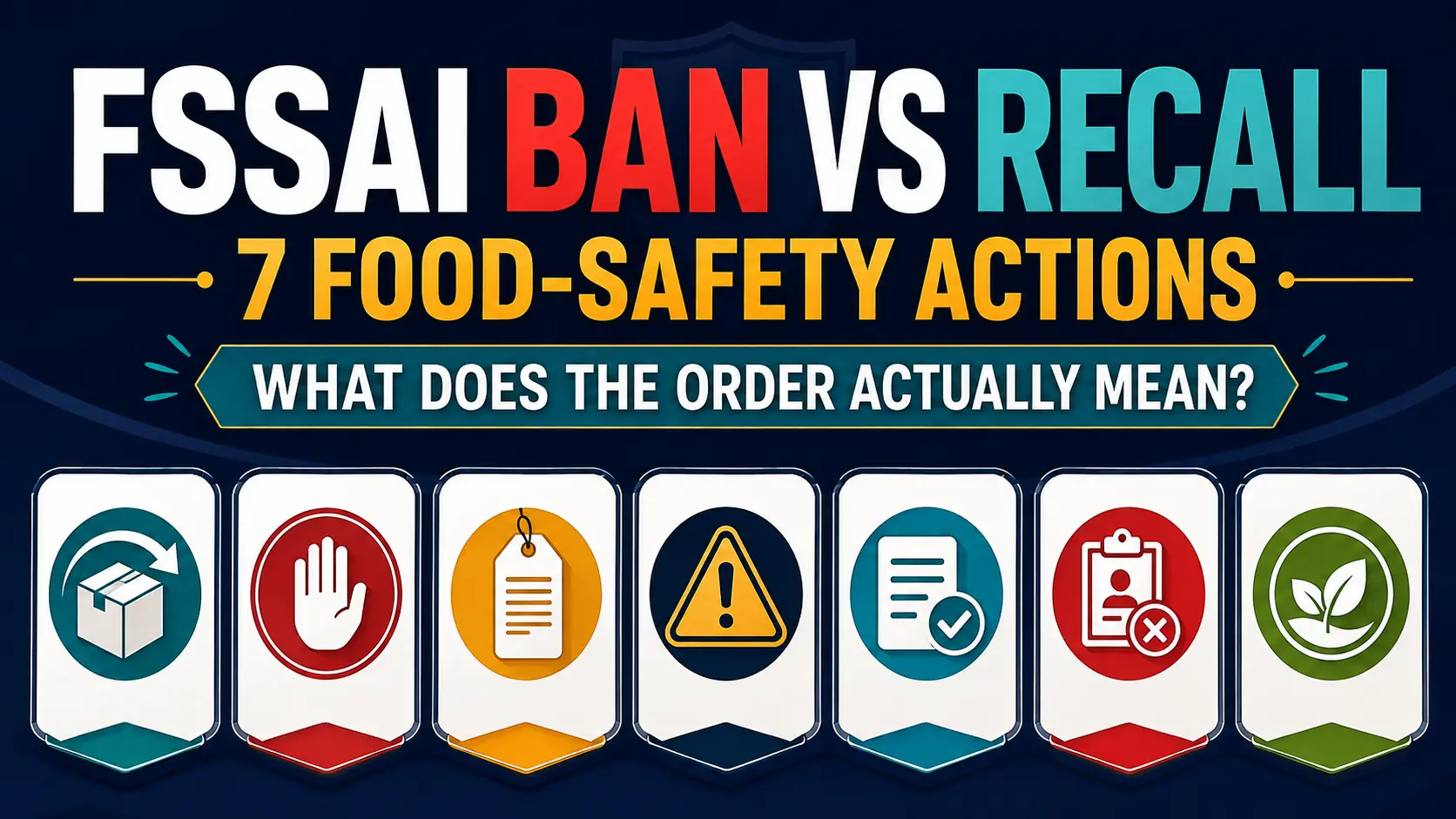
An FSSAI product ban, stop-sale direction, recall, misleading-label action and unsafe-food finding do not automatically mean the same thing.
A recall normally removes an identified food product from the market or from consumers. A claim-related order may instead require a business to stop using particular wording, advertisements, labels or representations without establishing that the product is contaminated or medically unsafe.
The practical rule: Do not decide what to do from the word “banned” in a headline. Find the exact authority, order, product identifiers, regulatory reason and consumer instruction.
- FSSAI ban vs recall: quick answer
- Seven food-safety actions compared
- What is an FSSAI food recall?
- What is a stop-sale or prohibition order?
- What is a misleading-label or claim violation?
- What is an unsafe-food finding?
- What does licence suspension or cancellation mean?
- What does an organic-certification problem mean?
- How consumers should check an FSSAI order
- What to do with a product already purchased
- How to report a misleading food claim
- Verification method
- Limitations and unresolved facts
- Frequently asked questions
FSSAI ban vs recall: what is the difference?
A food recall is a defined process for removing an identified food product from the supply chain, including products already possessed by consumers, where the food may pose a public-health threat or violate applicable food law.
A product prohibition or stop-sale direction can be narrower. It may prevent sale:
- under a particular label or claim;
- from a particular facility;
- through a particular seller or channel;
- for a specified batch or product;
- until a regulatory defect is corrected.
A misleading-claim action may concern the truthfulness of words such as “pure,” “natural,” “organic,” “sugar-free” or another representation. Such an action does not, by itself, prove that the product contains a dangerous contaminant.
“Banned” is often headline language, not the complete legal classification. The signed order or official notice should control the interpretation.
Seven FSSAI actions consumers should distinguish
| Action | What it generally means | Does it automatically prove the food is unsafe? | What consumers should check |
|---|---|---|---|
| Food recall | An identified product is being removed from the market, supply chain or consumers. | No single reason applies to every recall, but the notice indicates a material regulatory or safety concern requiring removal. | Brand, product, batch, dates, reason and return or disposal instruction. |
| Stop-sale or prohibition order | Sale is halted under the conditions stated in the order. | No. The reason may concern safety, composition, labelling, claims or another violation. | Exact product, claim, channel, seller and duration. |
| Misleading-claim action | A label, advertisement or representation is considered false, ambiguous or inadequately substantiated. | No. | Which words or claims are disputed and whether relabelling is permitted. |
| Unsafe-food finding | The authority has identified a safety-related failure under food law. | It establishes a safety concern within the scope of the finding. | Product, batch, hazard, affected population and official health advice. |
| Labelling correction | Required information, declarations or presentation must be corrected. | Not ordinarily by itself. | Whether sale continues, stops temporarily or resumes after correction. |
| Licence suspension or cancellation | The food business operator’s permission to operate is restricted or withdrawn. | Not automatically for every product sold by the business. | Premises, licence number, activity and products within scope. |
| Organic-certification or logo violation | An organic claim or certification representation may not meet the applicable requirements. | No. | Certification system, licence number, logo and product registration. |
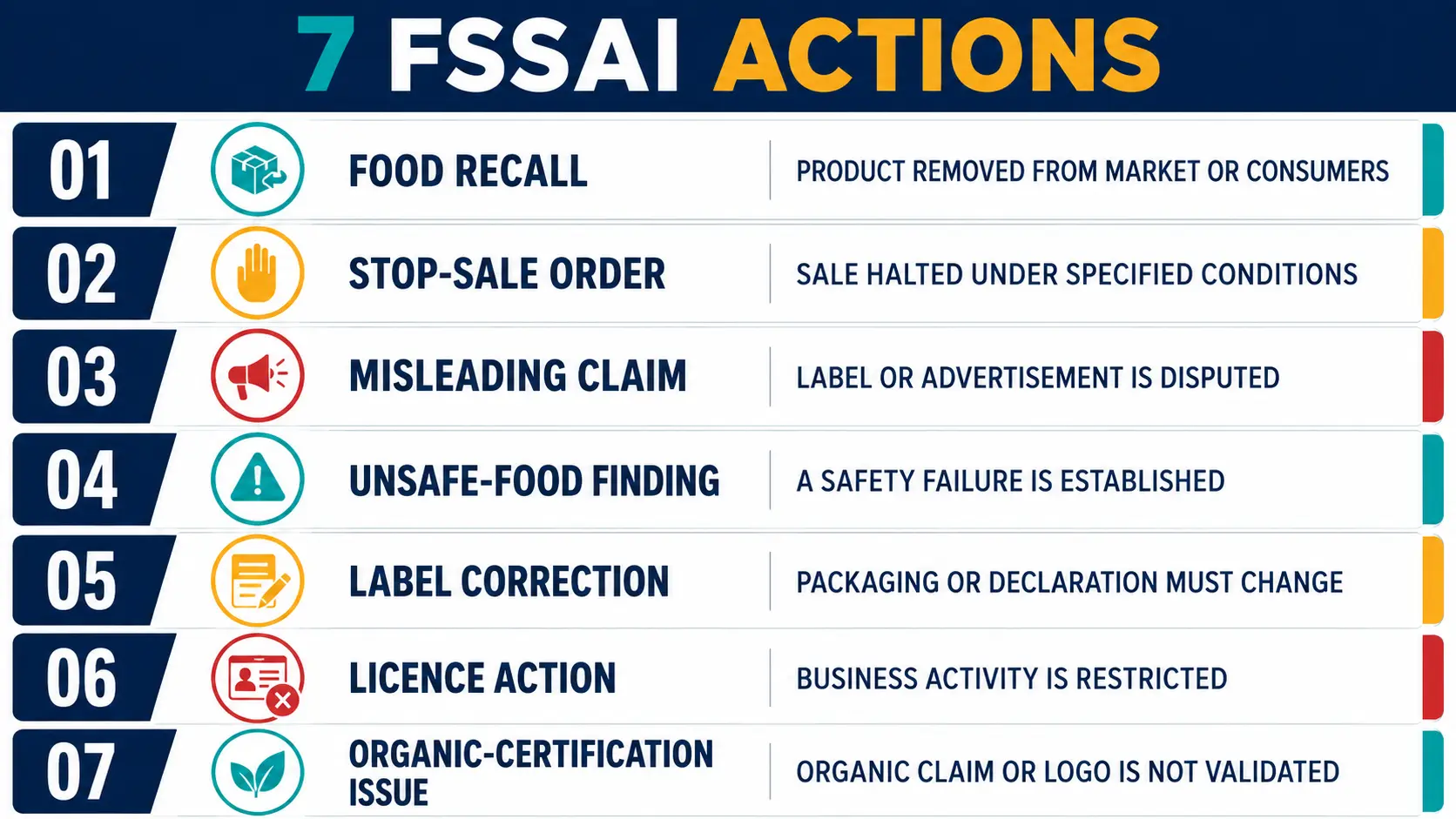
The table and infographic are consumer interpretation tools. The final meaning of any action depends on the controlling order, regulation and facts.
What is an FSSAI food recall?
FSSAI defines recall as an action to remove food from the market at any stage of the food chain, including food already possessed by consumers, where the product may threaten public health or violates the Food Safety and Standards Act, rules or regulations.
FSSAI’s public recall system uses fields such as:
- recall ID;
- food business operator;
- brand name;
- batch or lot number;
- product;
- reason for recall;
- recall start date;
- recall status;
- recall termination date.
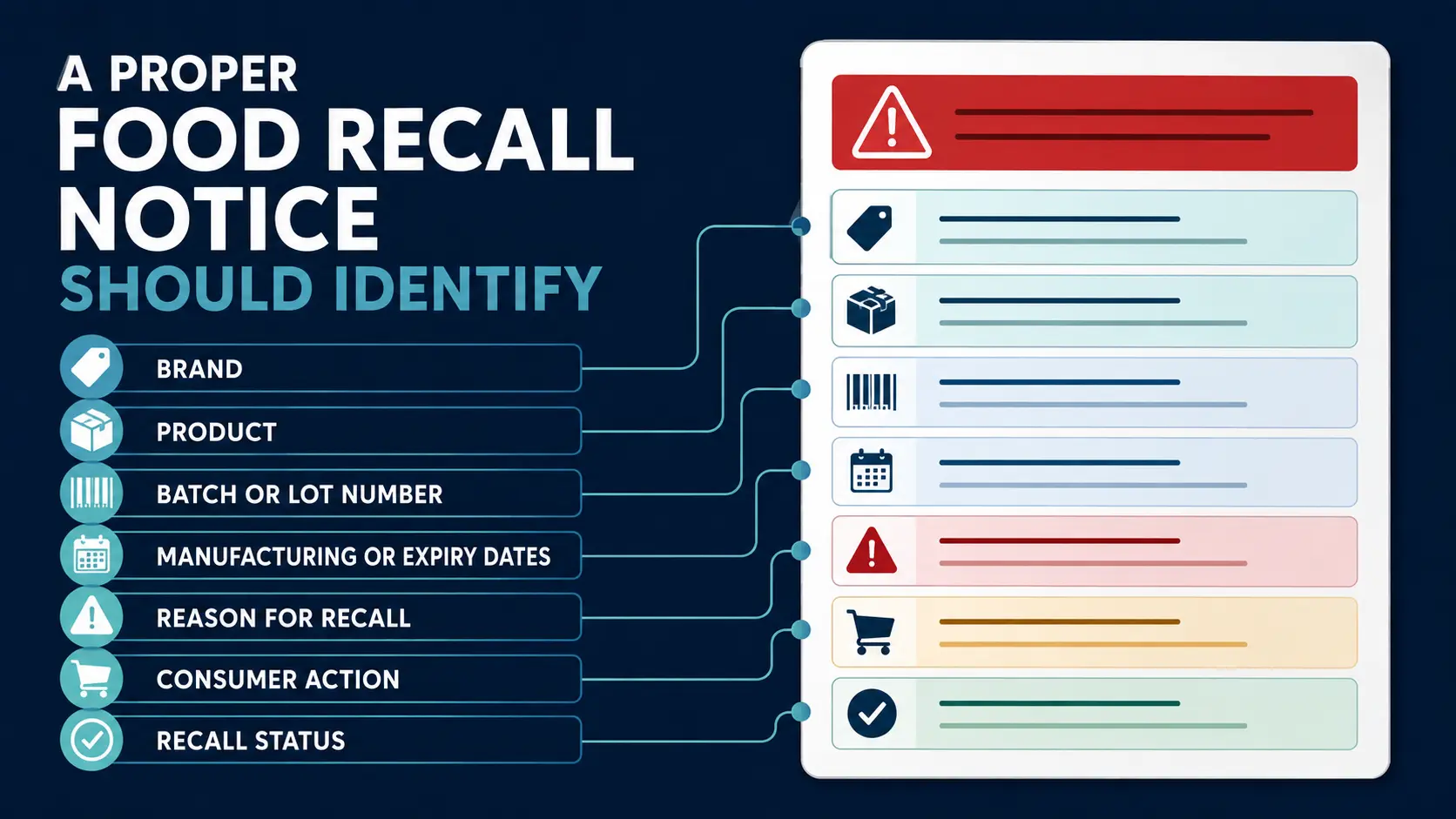
This is why a proper recall should normally be more specific than a news headline stating only that a brand or food category has been “banned.”
A recall can reach consumers directly. A stop-sale direction may operate mainly at the manufacturer, distributor, retailer or platform level unless the order also requires consumer return or disposal.
What is a stop-sale or prohibition order?
A stop-sale or prohibition direction prevents continued sale under the conditions stated by the authority.
The scope may be:
- one product;
- one batch;
- one package or label;
- one prohibited claim;
- stock held at a facility;
- all sales by a business until compliance is restored.
Consumers should therefore ask:
- What exactly is prohibited?
- Who has been ordered to stop selling?
- Does the order identify batches?
- Does it tell consumers to return anything?
- Can sale resume after correction?
What is a misleading-label or advertising-claim violation?
FSSAI’s Advertising and Claims Regulations govern claims and advertisements made by food businesses.
A claim can attract regulatory action where it is:
- false;
- ambiguous;
- exaggerated;
- not meaningful to consumers;
- not supported by adequate evidence;
- likely to create a misleading impression.
The legal question may concern what the packaging or advertisement promises, rather than whether the food failed a contamination or adulteration test.
What is an unsafe-food finding?
An unsafe-food finding is materially different from a claim dispute. It means the authority has identified a food-safety problem within the scope of its investigation or test.
Evidence may involve:
- harmful contamination;
- prohibited substances;
- microbiological failure;
- dangerous foreign material;
- composition that creates a safety risk;
- another statutory unsafe-food condition.
The notice should be checked for the exact product, batch, test result, affected consumers and recommended action.
Do not reverse the logic. A misleading label does not automatically prove unsafe food, and a compliant-looking label does not guarantee that no safety defect exists.
What does FSSAI licence suspension or cancellation mean?
Licence action concerns the legal ability of a food business operator or premises to carry out specified food activities.
It may follow:
- serious or repeated non-compliance;
- failure to correct deficiencies;
- unsafe operating conditions;
- licensing or inspection violations;
- other breaches under the applicable framework.
A licence suspension does not automatically mean every product ever sold under the brand has been declared unsafe. Consumers should identify the licensed entity, premises, product scope and date.
What does a Jaivik Bharat or organic-certification problem mean?
The Jaivik Bharat logo is FSSAI’s identity mark for distinguishing organic food produced under recognised organic standards.
FSSAI’s organic-food FAQ says consumers should look for:
- the Jaivik Bharat logo;
- the FSSAI logo and licence number;
- the relevant NPOP or PGS-India certification mark where applicable.
A disputed organic claim or logo can mean that the representation is not supported through the required certification route. It does not automatically prove the food is contaminated or dangerous.
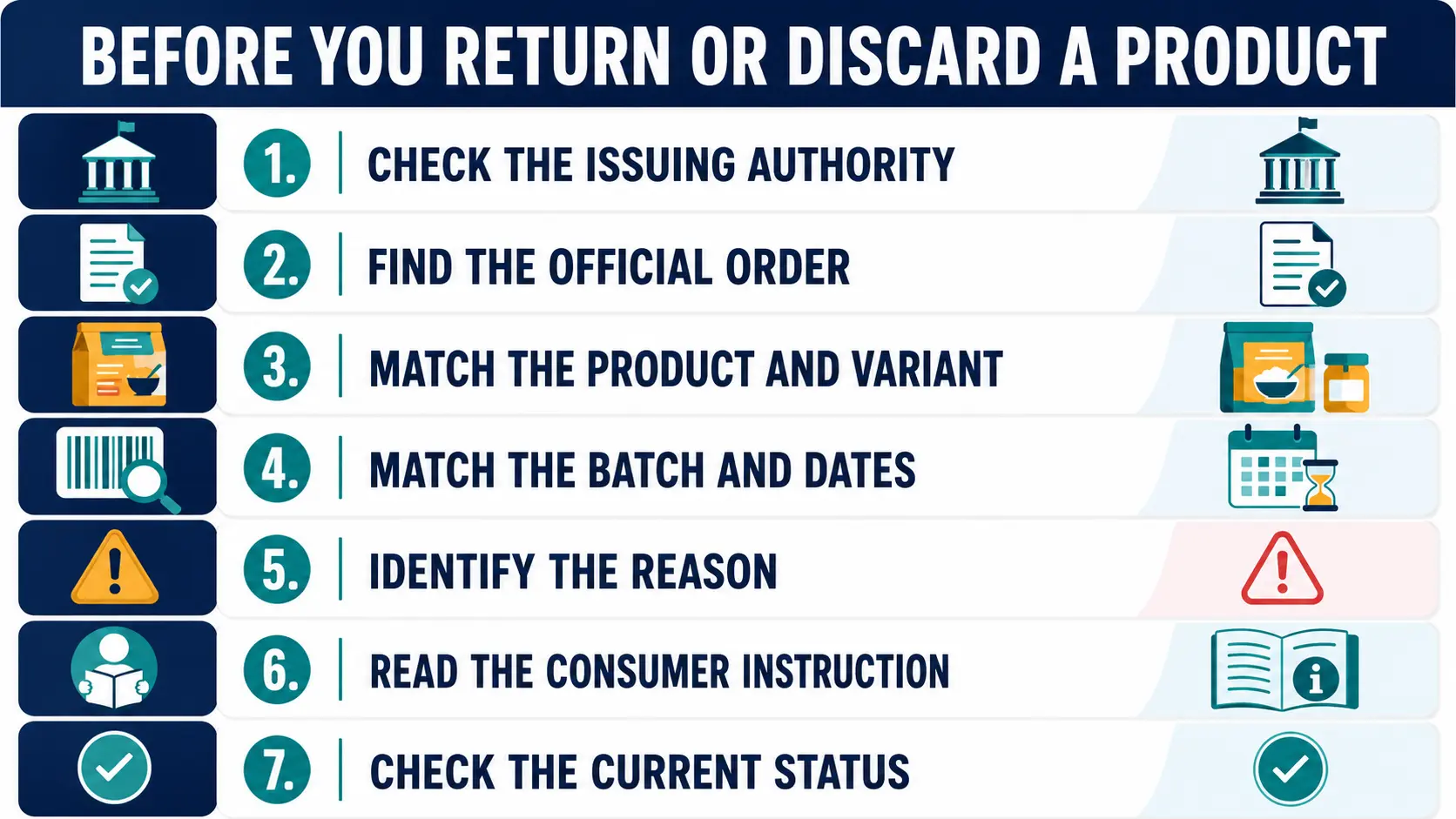
How to check the exact scope of an FSSAI order
-
Identify the issuing authority.
Confirm whether the information comes from FSSAI, a state food-safety authority, a court, the company or only a news report. -
Find the signed notice or official recall entry.
A headline may simplify or misclassify the action. -
Match the exact product.
Check brand, product name, variant, pack size and category. -
Match the batch and dates.
Many recalls and safety alerts apply only to specified lots, manufacturing dates or expiry periods. -
Identify the reason.
Determine whether the issue concerns safety, composition, labelling, advertising, certification or licensing. -
Check the consumer instruction.
Look for return, refund, replacement, disposal, avoidance or medical advice. -
Check the current status.
A recall may remain active, be expanded, be corrected or be formally terminated.
What should you do with a product already purchased?
Use the official instruction—not the headline—as your decision rule.
Until a specific recall or disposal instruction is confirmed:
- preserve the packaging;
- record the batch, manufacturing and expiry details;
- retain the purchase invoice where available;
- check FSSAI’s recall page and company notices;
- avoid consuming food that appears damaged, spoiled, expired or abnormal;
- seek medical advice if a concerning reaction occurs.
Consumers should not be told to discard a product solely because an advertisement or label claim has been challenged, unless the regulator or company issues a relevant safety or recall instruction.
How can consumers report a misleading food claim?
Before submitting a complaint, preserve evidence such as:
- clear photographs of the front and back labels;
- the exact disputed wording;
- batch, manufacturing and expiry details;
- invoice or online order record;
- advertisement screenshot or URL;
- seller or marketplace information.
The complaint should explain the exact claim and why it may mislead. Avoid alleging contamination, adulteration or illness unless there is evidence supporting that separate concern.
Related verified guides
- FSSAI Dabur claims order: ban, recall and safety questions explained
- India LPG and petrol shortage claims explained
- ITR filing deadline 2026 and late-filing rules
- SEBI PaRRVA framework explained
- Documents required to transfer shares after death
- CCMT National Spot Round registration, fees and reporting guide
Verification method
Method used: ThePulseSignal reviewed FSSAI’s official food-recall page, public recall database, Food Recall Procedure materials, Advertising and Claims Regulations, broader regulations index and the official Jaivik Bharat organic-food portal.
The recall definition and procedure were checked against FSSAI’s official recall resources. The public FoSCoS recall database was reviewed to identify the product-level fields used in recall records.
The Advertising and Claims Regulations were reviewed separately from the recall framework to avoid treating a misleading-claim action as automatic proof of an unsafe-food finding.
The Jaivik Bharat portal and organic-food FAQ were checked to understand how consumers can distinguish organic certification from an unsupported marketing statement.
Official sources reviewed
Limitations and unresolved facts
This article explains regulatory categories; it cannot determine the legal effect of a specific order without reviewing that order.
- News headlines may use “ban” more broadly than the controlling legal document.
- A single action may involve more than one category, such as recall, labelling and licence consequences.
- Consumer instructions vary by product, batch and hazard.
- The article cannot determine whether an individual product is safe to consume.
- It does not replace medical advice following a suspected food reaction.
- State food-safety authorities may issue separate directions.
- Recall records and order status may change after publication.
- Organic-logo presence should be checked with certification and licence information rather than treated as conclusive by itself.
Frequently asked questions
Does an FSSAI ban mean the food is unsafe?
Not automatically. The action may concern safety, labelling, an advertisement, certification, licensing or another regulatory violation. Check the exact order.
What is an FSSAI food recall?
It is a process for removing an identified food product from the market or consumers because it may threaten public health or violates applicable food law.
Is a stop-sale order the same as a recall?
No. A stop-sale order may prevent further sale without requiring consumers to return products already purchased. The order must be checked for its exact scope.
Does a misleading label prove adulteration?
No. A misleading claim and a laboratory-confirmed adulteration finding are different issues.
Should I discard a product after reading that it was banned?
Check the official notice first. Follow any confirmed recall, return, disposal or health instruction that matches the exact product and batch.
How can I check whether my batch was recalled?
Use FSSAI’s public recall database or the official company notice and match the brand, product, batch or lot number and relevant dates.
Can a product return after a label correction?
Possibly, depending on the order and regulator’s requirements. A label correction does not automatically guarantee that sale can resume immediately.
What does licence suspension mean?
It restricts the licensed food business or premises. It does not automatically declare every product associated with the brand unsafe.
What does the Jaivik Bharat logo indicate?
It is FSSAI’s identity mark for distinguishing organic food produced under recognised organic standards. Consumers should also check the FSSAI licence and relevant certification details.
Where can I check current FSSAI recalls?
FSSAI maintains a public recall database through FoSCoS with product, batch, reason and recall-status information.