






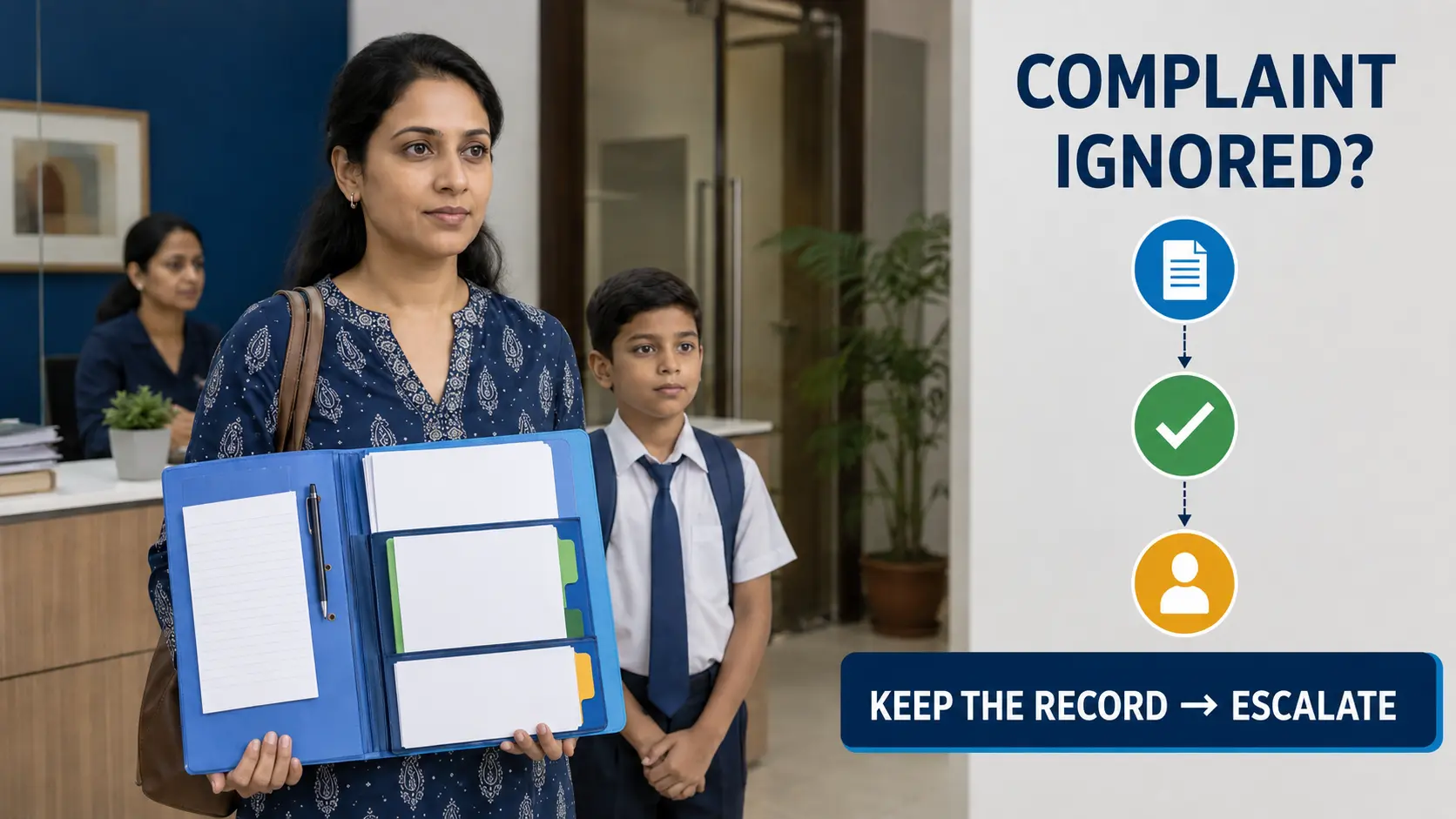
School complaint escalation in India should usually begin with the complaint you already filed — not with a brand-new version of the story. If a school, management or education authority has ignored your complaint, preserve the original submission, acknowledgement and response, identify exactly what remains unresolved, and then move to the authority that actually has power over that issue.
The next step is different for a fee dispute, RTE grievance, bullying concern, staff misconduct, withheld Transfer Certificate, false affiliation claim or disability-support problem. There is no single national “higher school complaint office” that automatically decides all of them.
Direct answer
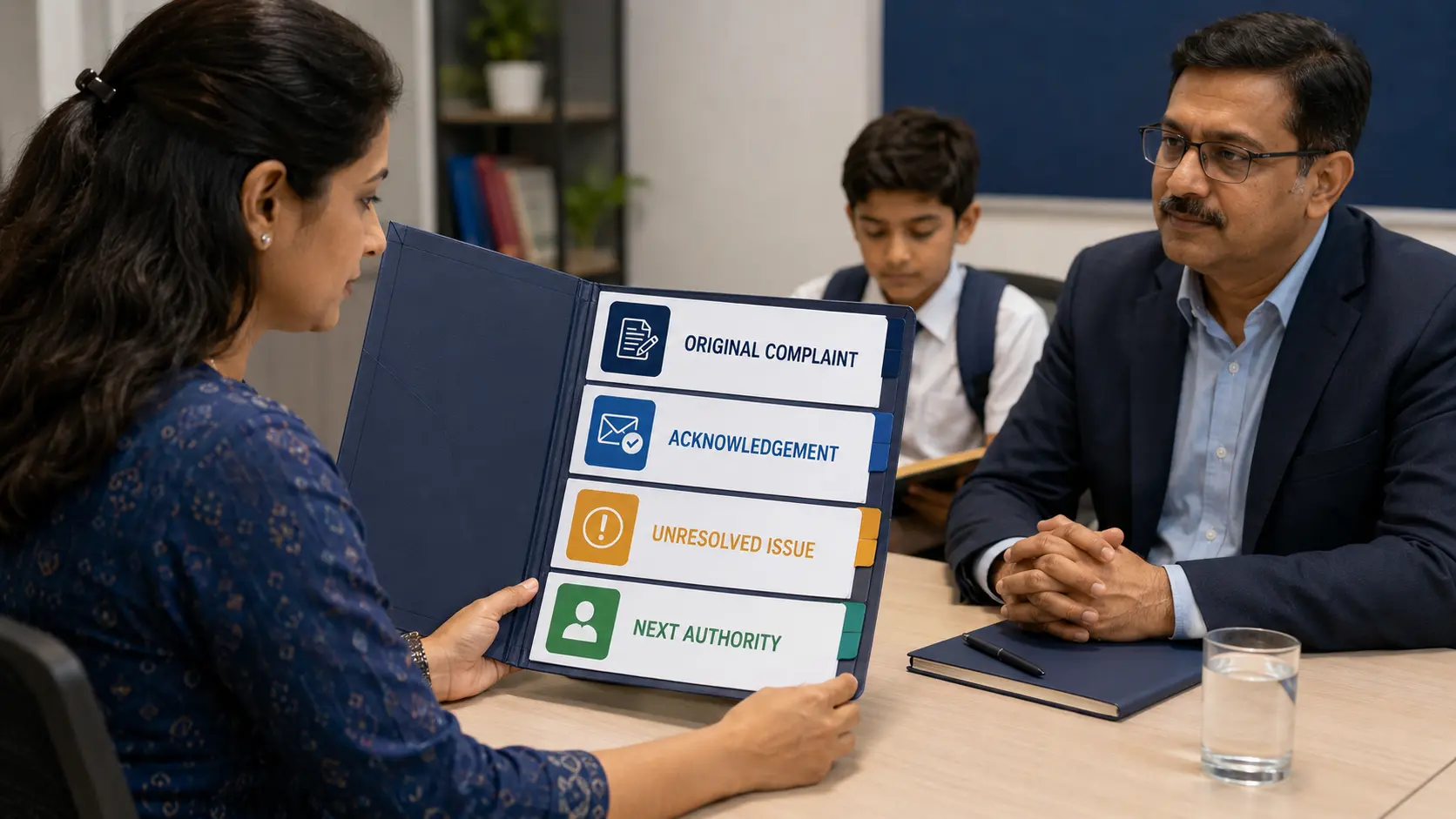
If your school complaint has been ignored, do not restart from zero. Build an escalation packet containing the original complaint, proof of submission, any response received, the unresolved issue and the remedy you are asking for.
Then identify the next competent authority. That may be a district or state education authority, a statutory fee body, an RTE grievance authority, a child-rights commission, a Board-affiliation mechanism or — where the unresolved grievance concerns a public authority’s service delivery — a public-grievance platform such as CPGRAMS.
If you have not yet identified what type of school complaint you have, start with Where to Complain Against School in India.
The next authority can depend heavily on the state’s fee-regulation law and whether a dedicated committee or authority exists.
First separate school-issued records from Board-issued documents and identify whether fees, RTE rights or another rule is involved.
If the school knew about bullying but the problem continues, escalation should focus on the child’s safety and the school’s response record.
Where the complaint concerns rights under the RTE Act, the statutory grievance-redressal structure must be checked.
Adult misconduct should not be routed as ordinary peer bullying or a generic school administration complaint.
If the issue is whether the school is recognised or is making an incorrect Board-affiliation claim, verify official status before escalating.
The complaint may involve education and disability-rights obligations rather than only general school administration.
Return to the national router rather than sending the same complaint randomly to multiple authorities.
Seven steps when a school complaint is ignored in India
Keep the original complaint
Do not rewrite the entire matter from memory. Keep the exact complaint you sent to the school or first authority.
Preserve proof that it was submitted
Save the email, stamped copy, portal acknowledgement, complaint number or other record showing when and where the complaint was filed.
Record what response you received
If the school replied, preserve it. If nothing was received, record that fact accurately instead of saying the complaint was “rejected.” No response and an adverse decision are different situations.
State what remains unresolved
The next authority should not have to guess what you want. Explain briefly what remains wrong after the first complaint.
Identify the authority with power over that issue
Fee regulation, RTE rights, child safety, Board affiliation and public-authority grievance handling can belong to different systems.
Escalate the same record
Attach or reference the first complaint, acknowledgement and response so the next authority can see the chronology.
Track the escalation and preserve the outcome
Keep the new complaint number, portal status, appeal reference and final response. If the authority provides an appeal or review mechanism, use that rather than starting an unrelated complaint.
Do not assume “no reply” automatically means you can skip to the highest national authority. The competent escalation level depends on what authority actually controls the dispute and what the applicable state or statutory process requires.
What should an escalation complaint contain?
Original complaint
Attach or quote the complaint that was already filed.
Submission proof
Include the date, email, portal ID, acknowledgement or stamped copy.
School or authority response
Attach any written response, order or explanation already received.
Short chronology
List the major dates so the new authority can understand the sequence quickly.
Supporting documents
Include only material relevant to the issue — for example fee notices, TC requests, incident records or affiliation evidence.
Specific remedy requested
State whether you want a review, correction, document release, safety action, fee determination, investigation or another identifiable outcome.
Do not confuse these three situations
| Situation | What it means | What to preserve | Possible next action |
|---|---|---|---|
| No response | The school or authority has not provided a decision | Submission proof and elapsed chronology | Follow the applicable reminder/escalation process |
| Complaint closed | A decision or closure has been recorded | Closure response and reasons | Use appeal/review if one exists |
| Complaint partly resolved | Some action occurred but the core problem remains | Original complaint plus what was actually done | Escalate only the unresolved portion |
Editorial interpretation: “my complaint was ignored” is often too broad for the next authority. A stronger escalation says exactly whether there was no response, an unsatisfactory closure, a partial remedy or a repeat problem after supposed resolution.
Can parents use CPGRAMS for a school complaint?
Sometimes — but CPGRAMS is not a universal private-school appeal tribunal.
CPGRAMS is the Government of India’s public-grievance platform for grievances relating to public authorities and service delivery. It is connected to Union ministries, departments and states.
The portal provides a unique registration ID for tracking grievances. Its current system also provides an appeal facility after closure where the complainant is dissatisfied with the resolution and follows the portal’s feedback/appeal process.
Important boundary: if your underlying dispute is only with a private school’s fee demand, document refusal or internal disciplinary decision, do not assume CPGRAMS itself has power to adjudicate that private dispute. It may become relevant where your grievance concerns how a government department or public authority handled the matter.
What if CPGRAMS closes the grievance and you disagree?
CPGRAMS currently states that after closure a complainant can provide feedback. Where the resolution is rated poorly, an appeal option is made available through the system.
This is different from simply filing the same grievance again.
That process applies to CPGRAMS grievances. It should not be presented as the appeal structure for every school complaint in India.
What if the complaint involves a child’s rights?
NCPCR operates e-BaalNidan, an online complaint-management system for child-rights grievances.
The complaint form allows details about the complainant, child, state, district and grievance to be provided, and it permits supporting files and relevant social-media links to be submitted.
The complaint can subsequently be tracked using the registered email or mobile number and complaint ID.
Use the issue, not just the frustration, to decide the route. A school not answering a routine administrative request does not automatically turn the matter into a child-rights case. The facts must actually support that route.
If your unresolved complaint is specifically about bullying or child safety, use the school bullying complaint India guide.
If a teacher or staff member is alleged to be responsible, use the teacher misconduct school complaint guide.
What if the complaint is about an RTE right?
The Right of Children to Free and Compulsory Education Act contains a specific grievance-redressal provision in Section 32.
The applicable local authority and implementation procedure must be checked for the state concerned. State notifications can designate the authority that receives RTE grievances; Delhi, for example, has issued notifications identifying its local authority for Section 32 purposes.
Do not treat RTE Section 32 as the appeal route for every school complaint. It is relevant to grievances relating to rights under the RTE Act.
For the statutory route itself, continue with RTE School Complaint in India.
What if the complaint concerns a CBSE-affiliated private school?
A school’s CBSE affiliation does not automatically move every grievance into CBSE jurisdiction.
CBSE’s published complaint guidance distinguishes complaints involving its own officials and complaints concerning private independent schools affiliated with the Board, while state-level education law can remain relevant to matters such as fees, local regulation and other school administration issues.
If the real problem is the school’s claimed affiliation or recognition, use:
School Affiliation and Recognition Complaint in India
What if you complained only verbally?
You may have difficulty proving when the complaint was made, what was reported and what response was requested.
If the situation is not an emergency, create a written record now. State briefly:
- when the earlier discussion happened;
- who you spoke to;
- what issue was reported;
- what action was requested; and
- what remains unresolved.
Do not falsely claim that a formal written complaint was submitted earlier if it was only discussed verbally.
Should parents keep sending reminders?
A reminder can be useful when an authority has a pending complaint and the applicable process allows follow-up.
But repeated reminders should not become a substitute for identifying the next competent authority where the complaint has clearly stalled.
There is no safe national rule such as “wait seven days, then escalate.” Official timelines, deemed outcomes and appeal periods must come from the applicable state, statutory or portal-specific framework.
What if the problem becomes urgent while you are waiting?
The fact that a complaint is pending does not mean a parent must ignore a new safety risk.
If circumstances materially change — for example a new serious incident, immediate danger or another potentially criminal allegation — document the new event and use the appropriate protection route rather than treating it merely as another reminder on the old administrative complaint.
For bullying and school-safety concerns, use the school bullying complaint guide.
Related school-problem guides
This page owns the question “I already complained — what do I do next?” The underlying issue should still be handled through its own canonical guide.
Common escalation mistakes
Starting from zero
The next authority needs the previous complaint and chronology, not an unrelated new narrative.
Sending the complaint everywhere
More recipients do not create jurisdiction.
Calling no response a rejection
Distinguish silence from an actual adverse decision.
Leaving out the remedy
Tell the authority what remains unresolved and what action you are seeking.
Ignoring an available appeal
If the competent system provides an appeal or review route, use it rather than repeatedly refiling.
Waiting despite a new urgent risk
A serious new safety event can require a different immediate response.
Verification notes: what is confirmed, variable and unresolved
Confirmed
CPGRAMS provides grievance tracking and an appeal facility within its public-authority grievance system. NCPCR operates e-BaalNidan for child-rights complaints. The RTE Act contains a specific grievance-redressal provision in Section 32.
State-specific
The competent education officer, local authority, state grievance portal, statutory committee and appeal hierarchy can vary by state and issue.
Not established nationally
There is no single national escalation authority that should be presented as having jurisdiction over every private-school complaint.
Parent takeaway
Preserve the original record, identify what remains unresolved and escalate to the authority that actually controls that issue.
Editorial interpretation: the most valuable escalation evidence is continuity. A parent who can show the original complaint, acknowledgement, response, unresolved issue and requested remedy gives the next authority a much clearer case than someone sending a fresh narrative to multiple agencies.
ThePulseSignal reviewed the current CPGRAMS public-grievance portal and its tracking/appeal description, NCPCR’s current e-BaalNidan registration and tracking systems, the Right of Children to Free and Compulsory Education Act’s grievance-redressal structure and CBSE’s published complaint guidance. State-specific escalation chains are intentionally not generalised without separate state verification.
Sources checked
Limitations and unresolved facts
This is a national escalation guide, not a universal state appeal chart.
- The exact next education authority varies by state and school type.
- RTE grievances must be tied to rights under the RTE framework.
- CPGRAMS concerns public authorities and service delivery; it should not be described as a tribunal deciding every private-school dispute.
- NCPCR’s e-BaalNidan is a child-rights complaint route, not the default escalation portal for every ordinary school disagreement.
- Board jurisdiction and state education jurisdiction are not interchangeable.
- Official deadlines, reminder periods and appeals require issue-specific verification.
- An urgent new safety incident can require a separate route even while an earlier administrative complaint remains pending.
School complaint escalation in India: FAQs
What should I do if my school complaint is ignored?
Keep the original complaint, proof of submission and any response. Identify what remains unresolved and escalate the same record to the authority that has jurisdiction over that issue.
How long should I wait before escalating?
There is no one national waiting period for every school complaint. Use any official timeline in the applicable state, statutory or portal process. Where no verified timeline is available, do not invent one.
Can I use CPGRAMS if the Education Department ignores me?
Potentially, where the grievance concerns a public authority or service delivery. CPGRAMS provides tracking and an appeal mechanism within its own grievance system. It should not be presented as the decision-maker for every underlying private-school dispute.
Can I complain to NCPCR if the school ignores a child-safety complaint?
NCPCR operates e-BaalNidan for child-rights grievances. Whether it is the appropriate route depends on whether the facts genuinely involve a child-rights concern.
Should I file the same complaint with five authorities?
Usually that is less useful than identifying the authority with jurisdiction. Different issues — fee regulation, RTE, child safety, affiliation and staff misconduct — can have different complaint systems.
What if my complaint was closed without solving the problem?
Preserve the closure response and identify the unresolved part. If the competent system provides an appeal or review process, use it. For CPGRAMS, the current portal provides feedback and an appeal facility after an unsatisfactory closure.
What if I only complained verbally?
Create an accurate written record now. Mention when the earlier discussion happened and what remains unresolved, but do not claim a formal written complaint existed if it did not.
What if the situation becomes dangerous while my complaint is pending?
A serious new safety issue should be treated according to the new facts rather than merely added as another reminder. Protecting the child takes priority over waiting for an ordinary administrative complaint to finish.
Last primary-source review: August 12, 2026.